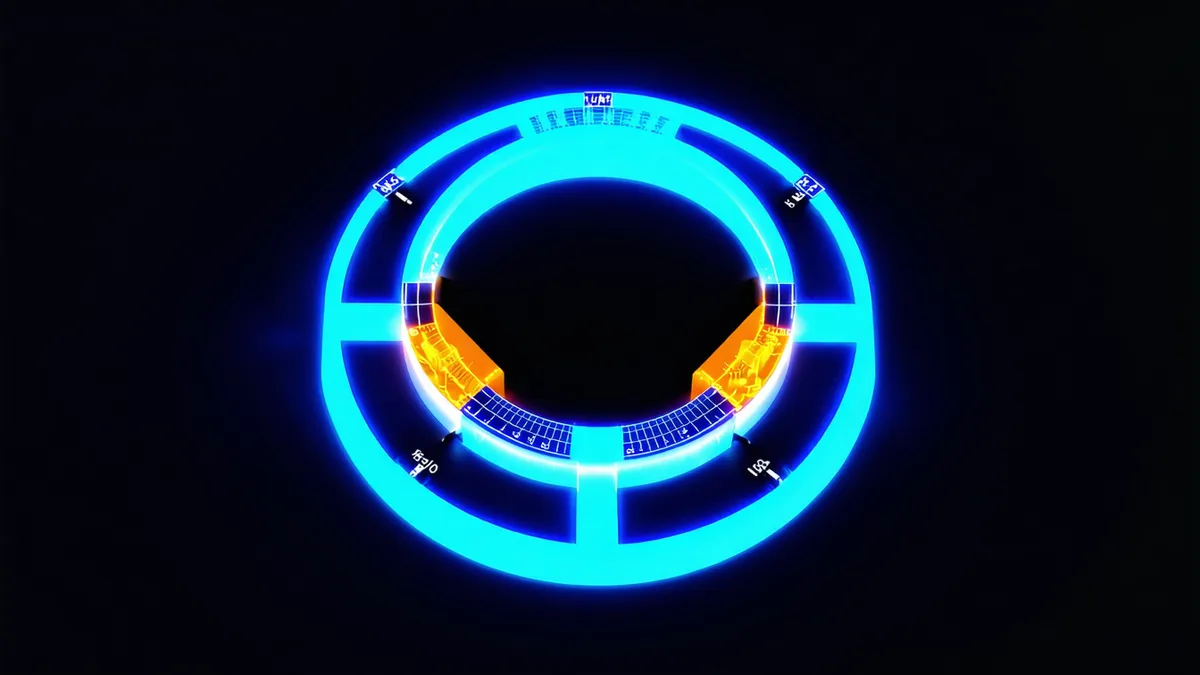
Micro-ring resonators are among the most layout-sensitive components in silicon photonics. A ring resonator that simulates correctly — showing the right free spectral range, the target Q-factor, and the designed coupling coefficient — can behave quite differently in the fabricated chip if three geometric parameters are not verified at the layout level: the ring radius, the coupling gap between the ring and its bus waveguide, and the waveguide width matching between the ring and the bus. Each of these parameters has a distinct effect on ring performance, and each is a distinct verification check.
This article covers the verification logic for each parameter, the physical mechanisms by which layout deviations translate to performance shifts, and the specific conditions that verification tools should check for ring resonator structures before tape-out.
Ring Radius and Free Spectral Range
The free spectral range (FSR) of a ring resonator is determined by the round-trip optical path length: FSR = λ² / (n_g × L), where λ is the operating wavelength, n_g is the group index of the waveguide mode, and L = 2π × R is the circumference of the ring for a simple circular geometry. The FSR is what determines which wavelengths the ring resonates at, which in turn determines the channel spacing and spectral response of any circuit using the ring as a wavelength-selective element.
The verification check for ring radius is simple in principle: extract the ring radius from the GDS-II geometry and confirm it matches the designed value within PDK tolerance. However, the extraction step is non-trivial because rings in GDS-II are approximated by multi-vertex polygons (GDS-II has no arc primitive). The verification tool must fit a circle to the polygon and extract the radius of that circle, then compare against the nominal radius specified in the PDK cell metadata or design netlist. For rings with tight FSR requirements (e.g., WDM channel spacing < 100 GHz), even a 100 nm radius error can produce a measurable FSR shift.
Additionally, ring resonators that use non-circular geometries — racetrack resonators with straight coupling sections, for example — require circumference calculation from the full polygon perimeter rather than simple radius extraction. The effective path length for a racetrack is L = 2π × R + 2 × L_straight, where L_straight is the length of each straight coupling section. A layout that specifies the wrong straight section length (a routing accommodation that the designer didn't account for in the FSR calculation) will shift the resonance positions by an amount that only becomes apparent at characterization.
Coupling Gap: The Most Sensitive Parameter
The coupling gap between the ring and its bus waveguide is the single most sensitive geometric parameter in a ring resonator layout, and the one most likely to be violated by fabrication process variation. The coupling coefficient κ depends approximately exponentially on the gap: reducing the gap by 20 nm can increase coupling significantly, while a 30 nm increase can substantially reduce it. This sensitivity means that a ring designed for critical coupling at 200 nm gap may be strongly over-coupled if the layout has a 180 nm gap (due to width expansion of both waveguides toward each other), or measurably under-coupled at 220 nm.
The coupling gap check reads the gap between the ring polygon and the bus waveguide polygon in the coupling region. In a PDK cell-based design, this gap is declared in the cell metadata and should be confirmed against the actual geometry. In a design with custom ring parameters, the gap must be extracted directly from the polygon-level geometry — measuring the perpendicular distance between the ring outer edge and the bus waveguide inner edge at the coupling region, accounting for the curvature of the ring wall in this region.
PDK rule decks for ring resonators specify both a minimum coupling gap (below which coupling is too strong for most intended applications) and a recommended gap range for common coupling ratio targets (50/50, 90/10, etc.). The verification check should flag:
- Any ring coupling gap below the PDK minimum (hard violation)
- Any ring coupling gap in a "high-variation-sensitivity" zone where small gap changes produce large coupling ratio changes (warning — annotate for process margin review)
- Any inconsistency between the gap in the layout and the gap declared in the cell metadata or design specification (mismatch violation)
Waveguide Width Matching Between Ring and Bus
A ring resonator consists of two optically coupled structures: the ring waveguide and the bus waveguide. For optimal coupling efficiency and for the ring to operate as a resonator with the designed Q-factor, both waveguides should be the same width (in a symmetric ring design) or the specific widths required by the PDK model. Width mismatch between the ring and bus waveguide creates two problems.
First, it introduces mode mismatch at the coupling region. The evanescent field coupling between two waveguides of different widths is less efficient than between two identical waveguides at the same gap. This reduces the effective coupling coefficient below what the gap alone would predict, which shifts the ring toward under-coupling relative to the design intent.
Second, it changes the phase accumulation in the ring relative to the bus. The resonance condition requires that the round-trip phase in the ring equals an integer multiple of 2π. If the ring waveguide is designed at width w_ring with effective index n_eff(w_ring) and the designer accidentally uses a PDK cell with a slightly different ring width — a cell version mix, for instance — the effective index shifts, the resonance positions move, and the channel alignment shifts by an amount proportional to the effective index change.
The width-matching check compares the declared waveguide widths of the ring cell and the bus waveguide at the coupling region. For PDK-based designs, this comparison reads the port width attributes from both cells and flags mismatches. For manually assembled geometries, it reads the polygon width from the geometry directly.
A Scenario: Ring-Based WDM Filter Array
Consider a design for a 4-channel WDM filter bank using add-drop micro-ring resonators on a 220 nm SOI platform, targeting 100 GHz channel spacing in the C-band. Each ring is designed with a 10 μm radius (FSR ≈ 9 nm at 1550 nm), a 200 nm coupling gap, and a bus waveguide width of 450 nm matching the ring waveguide width of 450 nm. The four rings are designed to resonate at four specific wavelengths, offset by the channel spacing through small radius adjustments (typically ±1–2 μm between channels).
Layout assembly uses PDK ring cells from the foundry library. During revision 4 of the layout, a designer substitutes one ring cell for a version from a newer PDK release — intended to use an improved ring shape with better fabrication yield. The new cell has a ring waveguide width of 480 nm instead of 450 nm, a difference not visible in the GDS-II top-level view because the cell dimensions are similar. The bus waveguide remains at 450 nm.
Three problems are introduced: width mismatch between ring and bus (30 nm, producing slightly reduced coupling coefficient), a slight FSR shift in that ring due to the different effective index at 480 nm width, and a potential resonance wavelength offset that misaligns the channel from the 100 GHz grid. The geometric DRC passes — 480 nm is within the PDK single-mode width range. The LVS passes — all four rings are connected to bus waveguides in the schematic. Only the photonic verification run, comparing ring cell port widths against bus waveguide widths and checking the ring radius against the channel allocation specification, flags the mismatch on ring 3.
The fix is cell substitution — reverting to the correct PDK version for ring 3. Five minutes in the layout tool. Discovering the problem after characterization, when channel 3 is off-grid and the demultiplexer insertion loss is anomalously high for one channel, takes substantially longer to diagnose.
Thermal Tuning Structures and Verification Scope
Many ring resonator designs include integrated thermal tuners — metal heaters or doped silicon resistors overlying the ring — for post-fabrication alignment of the ring resonance to a target wavelength. These elements are necessary because fabrication variation shifts resonance wavelengths by amounts (typically 0.5–2 nm) that exceed the tolerance for temperature-insensitive operation.
Verification of thermal tuner structures is partly optical (the heater placement relative to the ring must provide adequate thermal overlap with the optical mode region) and partly electrical (the heater resistance and isolation must be within designed values, which involves the doped layer geometry and contact via placement). For photonic verification purposes, the primary check is that the heater structure is present, correctly positioned relative to the ring core, and not creating an unintended optical interaction — metal in direct contact with the waveguide causes absorption loss, so the PDK specifies a minimum clearance between metal layers and the waveguide core.
We're not saying that thermal tuner characterization removes the need for precise ring geometry at layout — even with tuning, a ring whose coupling gap is wrong by 50 nm is operating in a different coupling regime than designed, which no thermal tuner can correct. Thermal tuning compensates for resonance position drift; it cannot correct fundamental coupling design problems. Geometric verification of the coupling gap remains essential regardless of whether thermal tuning is included.
Summary of Ring Resonator Layout Checks
The complete set of photonic verification checks for a ring resonator in a production PIC layout covers:
- Ring radius / circumference: Extracted from GDS polygon, compared against nominal value in cell metadata or design spec. Tolerance: typically ±5–10 nm radius, depending on FSR sensitivity for the application.
- Coupling gap: Extracted from polygon-level gap measurement at the coupling region. Must be above PDK minimum; should be within PDK recommended range for intended coupling ratio.
- Ring-to-bus width match: Port width comparison at the coupling interface. Mismatch above PDK tolerance is a warning or violation depending on severity (≥ 20 nm mismatch is typically a high-severity warning).
- Bus waveguide continuity: No abrupt width changes in the bus waveguide within the coupling region length — these would invalidate the coupling model that assumes uniform width in the coupling section.
- Heater clearance (if present): Minimum distance between heater metal and waveguide core, per PDK metal-to-waveguide clearance rule.
- Proximity to adjacent rings: Rings that are too close together can optically interact through their bus waveguides (dual-bus crosstalk) or through direct evanescent coupling if ring-to-ring distance is insufficient.
These checks collectively provide a verifiable pre-tape-out confirmation that the ring resonator geometry will produce a device with the intended optical characteristics, within the uncertainties imposed by process variation — which is the maximum guarantee that layout-level verification can provide.